How to Buy Pipe

Have a question?Give us a call now, or fill out our online form.

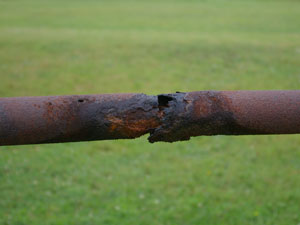
An example of internal corrosion that has decayed through the fence top rail
More and more lately, I have been getting calls from people pricing materials for the fencing of corrals, arenas, working pens etc. with a lot of confusion going on. They want to make sure they are comparing apples to apples and from the sound of it, there are a lot of apples and oranges out there. I get a lot of questions about gauges, schedules (relating to wall thickness) and about used vs. new vs. reject vs. secondary vs. surplus. Questions like: what is the difference between schedule 30 and schedule 40? How come as a “schedule” gets bigger, the pipe gets thicker, but as a “gauge” gets bigger, the pipe gets thinner? Is used pipe OK to use? What’s the difference between “new” pipe, “new reject” pipe” and “new secondary” pipe?

Well, these are indeed good questions and not all of us are blessed (or cursed) with over four decades in the pipe and steel business. Furthermore, with the wildly fluctuating steel prices these days, and the fact that steel is still by far the best way to fence livestock, it is very important to understand what you are buying. It is also very important not to waste money by over killing your needs. So when I was asked to write this article, I was happy to do it. Maybe it will save me a few hours on the telephone. So let’s break it down.

New vs. Used
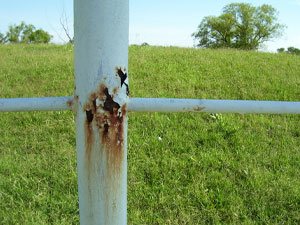
Used pipe is subject to decay from the inside out.

Let me tell you up front, I’m biased and I don’t have a lot of good things to say about used pipe. Now I’m not saying all used pipe is a bad buy, I’m just saying that MOST used pipe is a bad buy. Let me count the ways. First of all, the used oilfield pipe available for the fence market is pipe that is deemed no longer fit to be used in the oil patch. With the high oil prices and the pipe shortages, believe me, they (the oil operators) are wearing it out before they sell it off as structural.
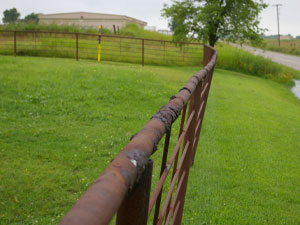
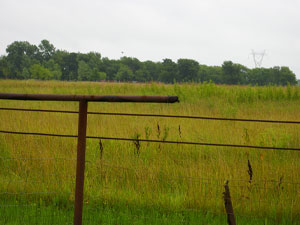
Unfortunately for this fence owner, the corrosion has affected almost his entire top rail
Here’s what happens: Let’s talk about salt water and oil production. Most of the existing wells in Oklahoma, Kansas and Texas are classified as stripper wells. These are wells that produce a lot of fluid on a daily basis but take it from my oil patch pipe days; the oil operators consider them selves lucky if they get a 10% “cut” in their production. This means that if the well produces 10 barrels of oil a day, it also produces 90 barrels of SALTWATER per day. Do I need to explain the effects of saltwater on steel? Don’t think so! Furthermore, periodically, acid is dumped down the wells to help the flow of fluids into the well bore. Hmmm, That can’t be good on the pipe. I think you’re getting it.
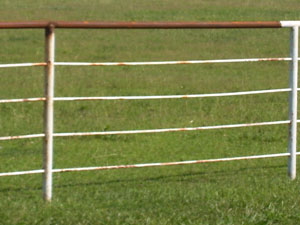
Used pipe is next to impossible to keep painted
Last but not least, let’s just touch on rod wear, the most destructive effect on oil field pipe. Bet you thought the hole that is drilled to make an oil well goes straight down…right? Wrong! That is what I thought when I first started selling oil country tubulars in the early 80’s. Well let me tell you, oil and gas wells are spiral! Without going into the dynamics of drilling into rock several thousand feet, you’re just going to have to take my word for it cause I hate to type. But if you really want to know, hey, I love to talk, so call 877-851-2365.
This fence is literally falling down
What were we talking about? Oh yeah. Rod wear. Inside the oilfield pipe, which a lot of folks call drill stem, are the sucker rods. Now very quickly, a brief lesson on oil production and artificial lift. The pumping unit sits on the surface. Attached to the horse head on the pumping unit is the bridle. Attached to the bridle is the polish rod. Attached to the polish rod are the sucker rods. Wayyyyy down the hole is the rod pump. Well, to pump this fluid (saltwater & oil) out of the hole, the horse head, the polish rod, the sucker rods and the pump have to go up & down, 60 minutes per hour, 24 hours per day, 365 days per year. OK, stop and think. All these rods, going down all this pipe, IN A SPIRAL HOLE, are rubbing against something and that something is YOUR USED PIPE. By the way, did I mention that sucker rods are harder than the hubs of H E double hockey sticks? Getting my drift on rod wear?
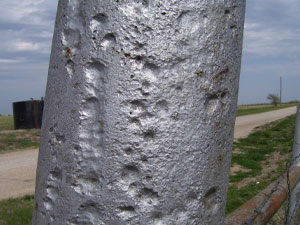
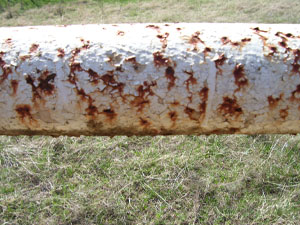
Used pipe is subject to pitting, internally and externally. This pipe has very little wall remaining.
To spell it out, these super hard rods, rubbing constantly against YOUR pipe, causes some very thin spots inside the pipe. Thus pipe that was nice and thick when it was new, has salt-water corrosion, acid corrosion and very thin spots due to “rod wear”. Does this sound like pipe that will last a lifetime? Don’t think so. How does an oil operator determine their pipe is no longer fit to re-use in their well? Usually there are 3 ways. The first is the easiest. They know their pipe has holes in it because their well is leaking down the backside or will not hold pressure, so they pull it out and get rid of it (hopefully not in your fence). The second way is by pulling the pipe out of the well and hydro-testing it. Here a service called “pipe testers” fill each individual piece of pipe with water then pressure up on it to see if it will hold the pressure or “pop”. This is where the splits we have all seen come from. Is all pipe without splits OK? Not necessarily. The third way to test is by electronic-magnetic inspection (known as an EMI). Here each piece of pipe is run through a high tech inspection unit that determines if there are thin places in the pipe.
The quality of used rods in recent years has declined, making them subject to sag.
There are four grades of EMI’d pipe. Most generally they use these specs: White band – Means pipe has a maximum of 12% body wall loss (this is new specs according to the API, we will cover this later). Yellow band – Means the pipe has a maximum of 15 % body wall loss. Blue band – Means the body wall loss is somewhere between 16 & 30%. Finally, Red band – Means the pipe has a body wall loss of over 30%. This is the pipe usually that is turned over for structural use. All the white, yellow & blue are reused in oil wells. Does that mean you should stay away from pipe with red bands painted on it? Well, probably yes, but many times the inspection companies simply do not paint the red band so you don’t really know.
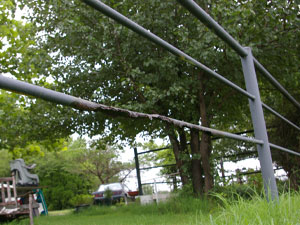
When using used pipe, you never know where the corrosion will break out. This fence was holding up pretty well except for the one rail
Now not all oil field tubing is like this. How can you tell? If you can look 30 feet down a 2″ or 2 ½” hole and see the internal condition of the pipe, you don’t need it any way. You’re too busy flying around in a red cape and jumping tall buildings in a single bound. Seriously, however, if you know the pipe came from a flowing gas well (they don’t use rods or produce salt-water) it is probably all right. Trouble is, unless you buy it right at the wellhead, it is hard to know. Enough bashing of used pipe. Let’s move on.

New Pipe

PIPE STANDARDS AND SPECIFICATIONS

The American Petroleum Institute (API) sets the standards and specifications for all Oil Country Tubular Goods (OCTG) and the American Society for Testing and Materials (ASTM) sets the standards and specifications for almost all other types of pipes.

Both institutions allow for a plus zero, minus 12% tolerance when it comes to the standards for the wall thickness on pipe. When referring to a size of pipe, it is called “nominal”. The term “nominal” describes all the specifications that go with it. It is a term that has pretty much been dropped out of the vocabulary when describing pipe, but you see it on most pipe charts and will hear a lot of old timers still using it.

NOMINAL VS. ACTUAL

So be careful when talking to a customer if you are selling it, or a salesman if you are buying it. For example, “2” pipe” could be 2 inches in outside diameter or it could be “nominal”, meaning the outside diameter is 2 3/8”. The term “nominal” also covers the specifications of the wall thickness, which includes the 12% tolerance mentioned in the third paragraph above. This really has a profound effect on the true cost of the pipe. Here’s how:

First of all, any pipe where the wall thickness is described by a “schedule” falls under the ASTM standards, which are all “nominal”. So, 2” nominal schedule 40 pipe actually has an outside diameter of 2 3/8”, and the maximum wall thickness is .154” with a 12% tolerance. Ah ha! Here is where it effects your price and where unscrupulous dealers take advantage of the uninformed public.

THE RIP OFF

It’s in the wall thickness! The wall thickness is specified to be .154”, but with minus 12% tolerance, it can be as low as .135”. Let’s examine what this does to the weight of the pipe:

At full specs, the 2 3/8” OD pipe with a .154” wall thickness will weigh 3.65 lbs. per foot. However, the same pipe with a wall thickness of .135” will weigh only 3.23 lbs. per foot.

Have you figured it out yet? Why dealers buy it by the pound, but sell it by the foot? Here’s a hypothetical situation. You call two different pipe dealers and ask for a price on 2 3/8” Schedule 40 pipe. Dealer A gives you a price of $2.31 per foot, and Dealer B gives you a price of $2.40 per foot. Who do you buy from, Dealer A or Dealer B? Most people will select Dealer A, right? An uninformed person would select A for sure, but an informed person would ask “what is your guaranteed minimum wall?” Let’s take a look:

Dealer A’s pipe was barely within tolerance to call it Schedule 40 so it weighs 3.23 lbs. per foot. Dealer B’s pipe is schedule 40 but they have a .150” minimum wall thickness. So it weighs 3.56 lbs. per foot. The difference is .33 lbs. per foot. More steel equals stronger and will last longer.

COST PER LB. VS COST PER FOOT

Both dealers buy from the same mill at the same price (per pound). Let’s say they pay $.65 per lb. Dealer A specs a maximum wall thickness, with tolerance makes it .136. Dealer B specs a minimum wall of .150”. This immediately gives Dealer A a 21 cents per foot advantage, at your expense!

Dealer A’s pipe, with 3.23 lbs. of steel per ft. converts to a cost of $2.10 per ft. plus profit when he sells it.

Dealer B’s pipe, with 3.56 lbs. of steel per ft., converts to a cost of $2.31 per ft. plus profit when he sells it.

Remember,

A quoted you $2.30 per foot for a profit of $0.20 per ft. (You pay $0.71 per pound.)
B quoted you $2.40 per foot for a profit of $0.09 per ft. (You pay $0.67 per pound.)

Now, as an informed buyer, you would select Dealer B of course.

DO DEALERS TAKE ADVANTAGE OF BUYING BY THE POUND THEN SELLING BY THE FOOT?

You better believe it!!!

Those dealers consider themselves smart for “playing the tolerance”. We call it dishonest. By selling pipe that is barely within tolerance, they have a distinct advantage over dealers, like GoBob, that are trying to provide high quality products. We will always specify the MINIMUM wall thickness. If they don’t say “minimum” wall thickness, you can bet your booty they are playing the tolerance game, and the actual wall thickness is about 12% under what they say it is. For example:

A .120 wall will be more like .106”
A .154” wall will be more like .135”
A .188 wall will be more like .165”

IT’S KINDA LIKE BUYING A DOZEN EGGS, BUT WHEN YOU OPEN THE CARTON, THERE’S ONLY 10 EGGS IN IT!

You should also know that foreign mills are the big culprits of making pipe at, or even a little under tolerance and they usually get away with it. When was the last time you took your ball anvil micrometer and checked your pipe? Probably never! Mexican mills are the worst with China right behind. Remember, The API and the ASTM are AMERICAN institutions. Mexican and Chinese mills could care less if they are caught cheating. They are free to set their own standards, and most dealers are happy to call the pipe what the mill called it, then plead ignorance if they are caught.

LUCKY FOR YOU, A COUPLE OF QUESTIONS WILL HELP YOU COMPARE APPLES TO APPLES.

1. Where was this pipe made? Be cautious if it is foreign. If it’s Mexico or China, hang up.

2. What is the ACTUAL wall thickness? If they don’t know, hang up.

3. Avoid the hassle and just call GoBob. 1-877-851-2365

THE END

Well, I could tell you a lot more but I’m tired of typing and sharing all my wonderful knowledge for free. Just kidding on the sharing knowledge part, but the two finger “hunt and peck” typing is the truth. It is, however, a lot easier for me to talk. And I love to talk about pipe, steel , horses and cattle. There’s other folks that like to talk, so if I’m already on the phone, bend their ears. Hope this helps ya!

Bob Studebaker and all the folks at GoBob Pipe.

Have a question?

Give us a call now, or fill out our online form.